
The gaming community has long speculated about threads connecting ConcernedApe’s two whimsical life-sim adventures, and the quiet silhouettes of Vincent and Jas may finally weave that tapestry. As 2026 settles into a rhythm of indie game anticipation, the imminent arrival of Haunted Chocolatier sharpens the lens on Stardew Valley’s most overlooked duo. Early glimpses confirm that the new title will stand as its own entity—a ghostly chocolate shop woven with combat and mystery—yet the universe already hums with echoes of Pelican Town. A subtle but powerful bridge could be built not with grand cameos, but with two children who once played in the dusty margins, now grown into the story.
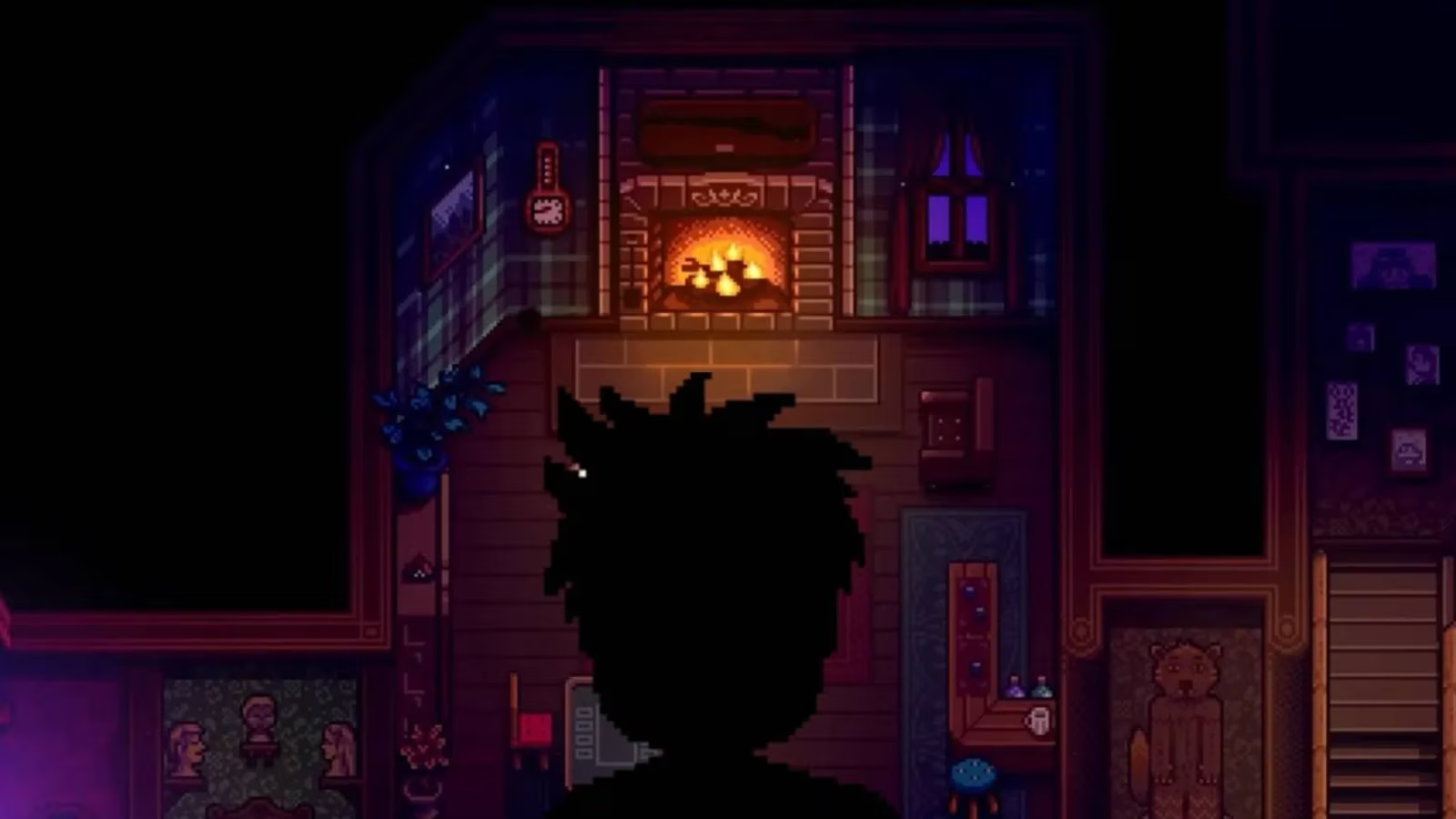
Both games shimmer with the same stardust. Haunted Chocolatier shares Stardew Valley’s rhythm of labor, friendship, and discovery, yet it pushes deeper into the eerie charm of a haunted city and the alchemy of artisan confectionery. Players who spent years cultivating ancient fruit and decoding villagers’ hearts will recognize the familiar pull: a balance between the mundane and the magical. But ConcernedApe has repeatedly hinted that the two worlds are not carbon copies. The new title is like a clockwork music box built from the same brass but playing a ghostlier melody. Still, the presence of shared DNA begs the question—why not let them inhabit the same breathing continent? A few recognizable faces could act as an emotional compass, grounding floating players while they learn to navigate spectral kitchens and moonlit foraging.
Among Stardew Valley’s cast, Vincent and Jas stand out precisely because they never stood out. They were the background static of summer days—two children chasing bugs near the sewer grate, sharing a single heart event that revealed little beyond their innocence. Their story arcs were thin as paper lanterns, leaving ample negative space for reinvention. In Haunted Chocolatier, this emptiness becomes a canvas. Imagine encountering them a decade and a half later: Vincent, now a young chocolatier’s apprentice with his father Kent’s guarded hope in his eyes, or Jas, carrying her small jump-rope secrets into a role as the town’s historian of ghost stories. Their reappearance would arrive like a mislaid seedling that somehow sprouts in foreign soil—unexpected, yet carrying the unmistakable scent of home.
This narrative device would also settle the calendar. A visible time skip—at least twelve to fifteen years—would be necessary for Vincent and Jas to emerge as adults with professions and personalities. Such a leap is a risky gambit, like tightening a bowstring until it sings a note you haven’t heard before. But it brings a rare reward: it confirms a shared timeline without entangling the canonical lives players built in Stardew Valley. Vincent and Jas were never marriage candidates, never pivotal quest-givers. Their minimal footprint means no romantic histories or rival heart events can contradict a player’s past. Older Vincent might recall the farmer’s gifts of snail shells with quiet warmth, while adult Jas could mention how the old Community Center restoration changed her view of the world—small, noncommittal winks that honor player agency while stitching the worlds together.
The potential for character depth is ripe. In Stardew Valley, the kids were windows into the emotional landscapes of their guardians—Vincent mirroring Jodi’s fatigue, Jas reflecting Marnie’s kindness. Freed from those domestic orbits, they could bloom into complex individuals. Perhaps Vincent, haunted by the shadow of his father’s war stories, finds solace in the meticulous tempering of chocolate, each glossy shell a small fortress of control. Jas, who once spoke to her doll as a confidante, might now serve as the bridge between the living and the spectral in a city saturated with restless spirits. These arcs wouldn’t just add flesh to bare bones; they’d feel like an archipelago finally charted—separate islands that prove to be part of the same submerged mountain range.
Skeptics may argue that Haunted Chocolatier must forge its own identity, free of nostalgic crutches. Yet a cameo need not be a crutch. It can be a lighthouse, not a port; it signals connection without demanding mooring. The sight of a familiar sunflower-haired woman or a certain turquoise-bandana-wearing adult would ripple through longtime fans as a quiet, personal Easter egg rather than a narrative hijacking. And because Vincent and Jas were so peripheral, their presence would feel earned by absence. They function like the bassline in a jazz ensemble—unnoticed in the original composition, but when reintroduced in a new key, they reshape the entire harmony.
Practically, the developers have a delicate path to tread. Shared universes in indie games often rely on subtle references—a shared brand of fictional cola, a recurring name in a library book. Vincent and Jas would be the most explicit link yet, but their obscurity protects the elegance. The average Haunted Chocolatier player might not even realize they’re Stardew Valley alumni until a piece of in-game dialogue flashes like a half-remembered dream: “My aunt has a ranch back in Stardew… she always had a soft spot for animals.” That moment, for those who catch it, would ripple outward like a stone dropped into still water, enriching both narratives without forcing them to merge.
As the release date draws nearer, the community’s speculation will only intensify. The silhouetted figure in the earliest trailer already sparked endless theorizing. Whether or not ConcernedApe chooses Vincent and Jas as the connectors, the idea highlights a fundamental truth: even the smallest characters can become keystones. In a genre that prizes community and continuity, letting the forgotten children of Pelican Town step into the lamplight of a new world feels like a promise kept. It would be a quiet announcement that the farm never truly disappeared; it just grew wild, and now, in a different shape, it’s ready to bear new fruit.