
I often find myself gazing at the digital horizon, not just as a player, but as a wanderer in worlds where the heart’s boundaries are redrawn by code and creativity. Isn't it fascinating how these crafted realities allow us to explore connections that our own world might frown upon? In the quiet hum of my console, I’ve discovered that romance in games isn't merely a subplot—it’s a canvas for human (and sometimes non-human) connection, painted with the brush of player agency. As we step into 2026, these virtual relationships have evolved from simple mechanics into profound narratives of choice, identity, and, yes, sometimes delightful chaos.
A Galaxy of Possibilities: Love in the Stars
When I first guided Ryder through the untamed wilderness of Mass Effect: Andromeda, I felt a peculiar freedom. The combat was sharper, the worlds vaster, but it was the romances that truly shimmered. Unlike the weighty, fate-of-the-galaxy stakes of Shepard’s era, Andromeda offered something lighter, more playful. Here, love wasn't a singular path but a constellation of options. I could pursue connections exclusive to my Ryder’s gender or explore intimate moments that transcended such binaries altogether. Isn't it liberating when a game acknowledges that the heart doesn't always beat to a monolithic rhythm? This progressive approach made each interaction feel personal, a quiet rebellion against narrative constraints.
The Whimsy of Wooing: When Everything is Dateable
Then, there are games that turn romance on its head with pure, unadulterated whimsy. Date Everything! isn't just a title; it's a philosophy. In its sandbox world, I found myself courting the uncourtable—objects, concepts, and entities that defy traditional labels. The marketing promised a riot, and the game delivered. 😊 It’s a visual novel that laughs at convention, allowing me to juggle multiple romances at my own pace without judgment. Why should love be limited to the animate? This game answered with a resounding, joyful "it shouldn't!" Its accessibility made it a gateway, proving that romantic VNs can be both profound and playful.
Wasteland Hearts: Love Amidst the Ruins
In the nuclear-scarred landscapes of Fallout 4, romance blooms like a stubborn flower in the cracks. It’s not central to the survival loop, yet it weaves through the narrative with quiet power. I remember Piper, her journalistic armor slowly giving way to vulnerability in shared moments. And Curie—ah, Curie—her journey into a synth body sparked deep questions. Can a machine love? The game doesn't answer, but it lets me explore that possibility without fear of partner jealousy. Isn't it intriguing how a post-apocalyptic world can feel more forgiving in matters of the heart than our own? While it might chip at immersion for some, for me, it was a welcome escape into emotional freedom.
Schoolyard Sweethearts and Urban Legends
Rockstar’s worlds have often been criticized for shallow romance, but even their earlier titles hold a quirky charm. Bully reduced wooing to gift-giving and stolen kisses across social cliques, yet there was an innocence to it. Jimmy’s struggles felt almost nostalgic. And then there’s Sleeping Dogs, a gem that too many overlook. As Wei, I could date five different partners, each unlocking unique perks in Hong Kong’s vibrant open world. 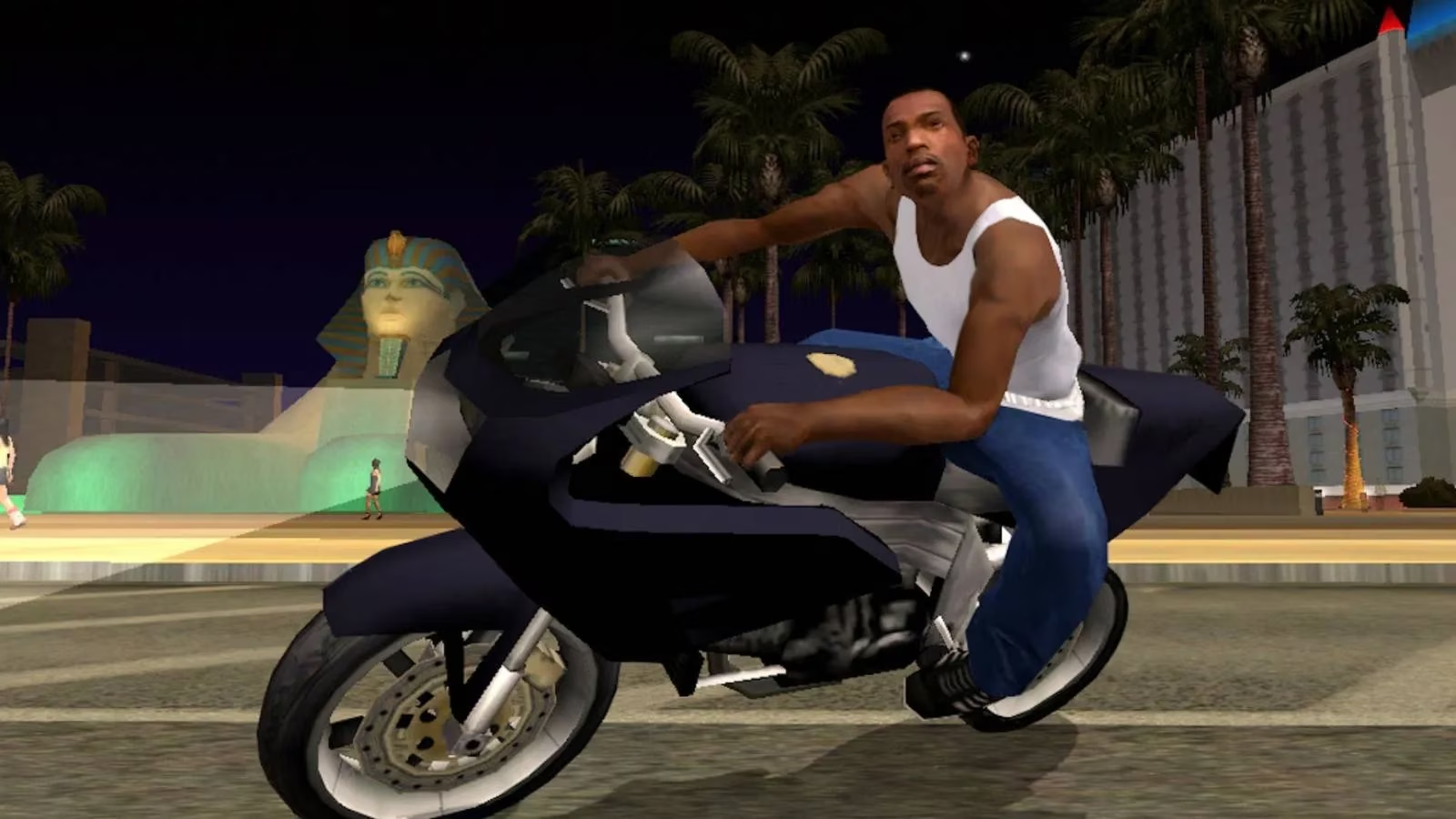 They might vanish after the courtship, but in those moments, they were distractions that enriched the experience. Why do we seek these connections even in chaotic worlds? Perhaps because they remind us of our own humanity.
Rural Romance and Digital Drama
Stardew Valley taught me that love requires work—and sometimes a little stalking. Its NPCs are so endearing that wooing them feels like nurturing a garden. The game allows multiple romances, though with a gentle nudge of guilt for unfaithfulness. Yet, the penalty is light, a whisper rather than a shout. It’s a balance that respects player choice while acknowledging emotional complexity. Meanwhile, The Sims 3 turned romance into a high-stakes drama. My Sims could be unfaithful, but secrecy was paramount. Getting caught could shatter relationships, even end marriages. Isn't it ironic how a life simulator can mirror real-world consequences so vividly?
Legacy of Freedom: CJ’s Enduring Journey
And then, there’s San Andreas, a masterpiece that let me live a second life through CJ. Dating four girls across its sprawling map felt like managing a delicate ecosystem. The relationship gauge demanded attention, but the game was merciful—partners in other cities wouldn't penalize absence too harshly. It was a small detail that spoke volumes about design empathy. In 2026, as games continue to evolve, this legacy of choice remains vital. Why should our digital selves be confined by monogamy when the imagination soars beyond?
A Comparative Glance at Romantic Freedom
| Game Title | Romance Style | Key Feature | Player Freedom |
|---|---|---|---|
| Mass Effect: Andromeda | Progressive, gender-inclusive | Lighthearted tone, multiple options | High (no jealousy mechanics) |
| Date Everything! | Whimsical, object-based | Sandbox VN, no restrictions | Very High |
| Fallout 4 | Narrative-driven, companion-based | Emotional depth, no partner pushback | High |
| Stardew Valley | Rural, friendship-based | Guilt system for unfaithfulness | Moderate (with minor penalties) |
| The Sims 3 | Life simulation, drama-focused | Consequences for infidelity | Low (risk of relationship ruin) |
| Grand Theft Auto: San Andreas | Open-world, activity-based | Relationship gauge, multi-city dating | Moderate (requires maintenance) |
In the end, these games offer more than escapism; they offer empathy. They let us ask: What if love wasn't a limit but a landscape? As I save my progress and power down, I carry that question into the night, grateful for worlds where the heart can roam free.